Fiverr UGC in 2026: a buyer's read on what the gig price does not tell you
search "fiverr ugc" and google returns fiverr, eight times over. no independent buyer's account in the top 20. this is that account: what the gigs cost, what the price tag cannot tell you, and the one measured number that decides whether a clip earns back what you paid for it.

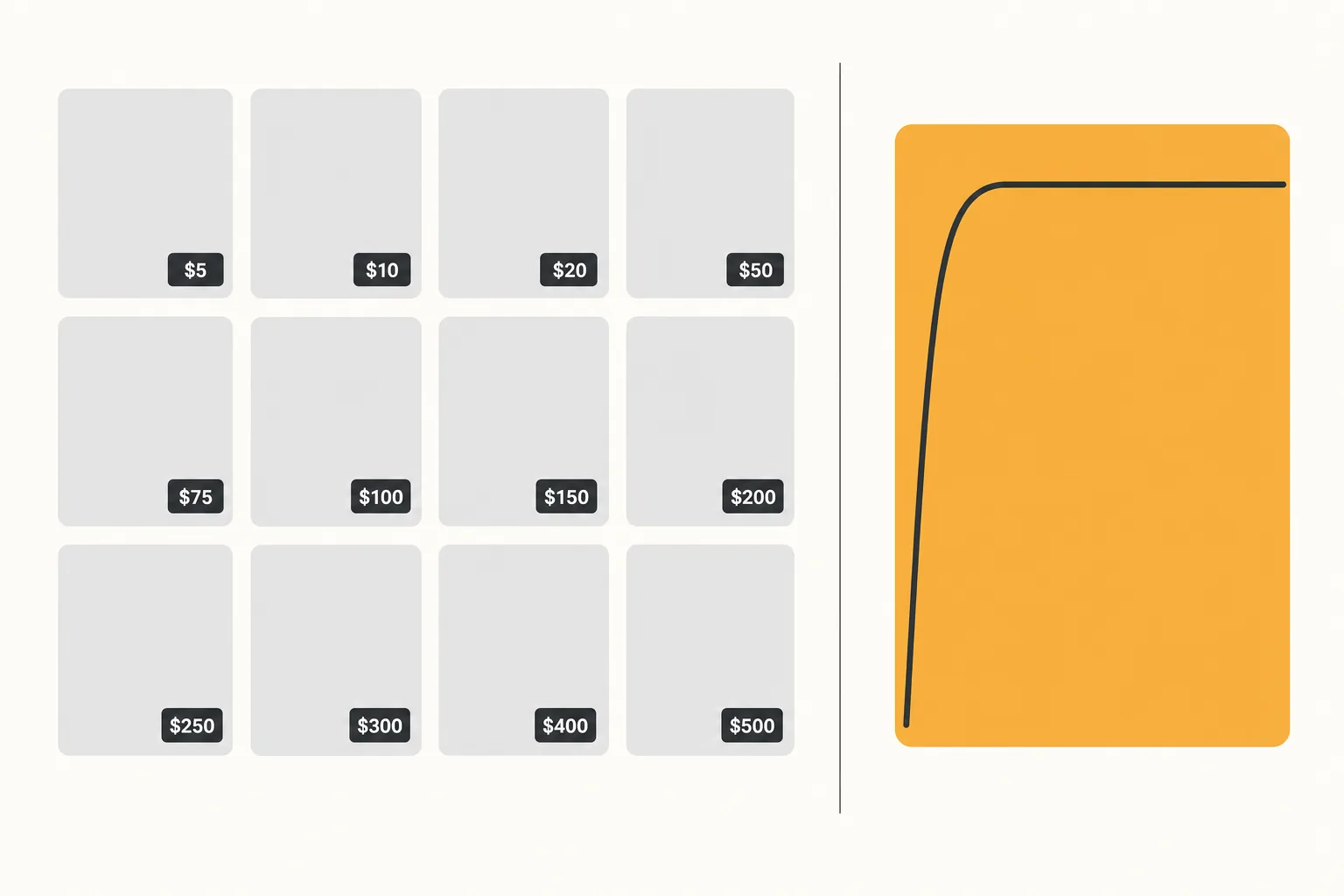
fiverr ugc is the pool of user generated content gigs sold on fiverr, priced per video by each seller rather than by a fixed rate card. it works fine as a sourcing channel. the problem is that the number on the gig page tells you almost nothing about the only variable that decides whether the video pays for itself.
that variable is hook rate. this page is about how to check it.
what the results page shows, and why that matters
we pulled the live results for "fiverr ugc" on 17 august 2026.
- position 1 is fiverr
- position 3 is a reddit thread in r/UGCcreators
- position 4 is fiverr
- position 6 is a linkedin post from a creator who ran 50 gigs
- positions 7, 8, 11, 13, 14, 17, 18 and 19 are fiverr again
- positions 10, 12 and 15 are youtube tutorials
- position 16 is instagram
ten of the sixteen organic slots are fiverr owned, nine on fiverr.com and one on its help subdomain. there is no ai overview.
two things fall out of that shape.
the first is obvious. this is a brand term and the brand owns it. fiverr ranks for fiverr, which is how google is supposed to work.
the second is the useful one. there is not a single independent article in the top 20. every result is either fiverr describing its own marketplace, or one person describing what happened to them. google is not rewarding a comparison table here. it is rewarding somebody who actually bought the thing and reported back.
so that is what this is.
what ugc costs on fiverr, and what it costs elsewhere
gig pricing on fiverr moves per seller, which is the whole model. the useful thing is not a single fiverr number, it is the spread across every sourcing route, because the spread is enormous and the output often is not.
here is what dan has published on his own sourcing, with the post behind each figure:
- $500 per post is what he says people are still paying at the top end
- $20 to $30 per post is the negotiated rate for us based creators
- $10 per video is what ai generated ugc costs, and veo3 sits at the same $10
- $3 to $4 per video is what real eastern european creators cost him
- $5 per video is the rate he now quotes publicly for the same format from real humans
that is a 100x spread between the top and the bottom of the range for a product category that is, functionally, one person holding a phone.
price is not the interesting part though. cheap footage that nobody watches is not cheap. it is just a smaller amount of wasted money.
the number the gig page cannot show you
hook rate is the share of viewers still watching after the first two to three seconds. it is the only early metric that reliably separates a clip that will scale from one that will not, because everything downstream, watch time, click through, install rate, is gated behind whether the viewer stayed at all.
no gig page reports it. it cannot. the seller has never run your creative against your audience.
what a gig price does tell you is your downside. what it never tells you is your ceiling, and the ceiling on a cheap clip is the whole reason to buy more than one. dan published a single $4 reaction that ran to 500k views at a 0.008 CPM, posted 1 november 2025. that is the outcome you are buying a ticket to, and no seller can promise it to you in advance.
there is a measured hook-rate comparison too, from a customer running our clips against their own account average. it is one customer on one account reporting their own number, not a controlled study, and it is written up with that caveat in ai ugc against real human ugc.
the mechanism behind it is not complicated. a hook is not a face. it is a reaction. the half second where somebody visibly feels something about your product. confused, caught off guard, surprised. that beat is what stops the scroll, and it is the thing a script cannot instruct into existence.
what a reaction clip actually is
this is the format the numbers above were measured on. two clips from the library, unedited, $5 and $7.50:
notice what is doing the work. neither clip is well lit, expensively shot or carefully framed. what carries them is that the expression changes on camera, and it changes fast enough that you see the turn happen.
that is the whole product. you are not buying a video. you are buying the half second that makes somebody stop.
is fiverr worth it for ugc
sometimes, and it depends on what you are short of.
fiverr is the right call when:
- you need one specific person, a particular accent, age or look, and you are willing to brief and revise
- you need spoken script delivery rather than a reaction
- you are testing whether ugc works for you at all and want a single video before committing to volume
- you want buyer protection and a dispute process on a first order with an unknown seller
fiverr is the wrong call when:
- you need volume. briefing, waiting and revising per seller does not compress, and hook rate only reveals itself across a batch
- you need a predictable unit cost. a per seller market means the rate moves every time you rebook
- you need the clip this week. turnaround is whatever each seller says it is
the volume point is the one that decides most cases. one video tells you nothing. the $4 clip that hit 500k views was not identifiable as the winner before it ran, which is exactly why buying one carefully briefed gig is the wrong shape. you get that outcome by testing enough hooks.
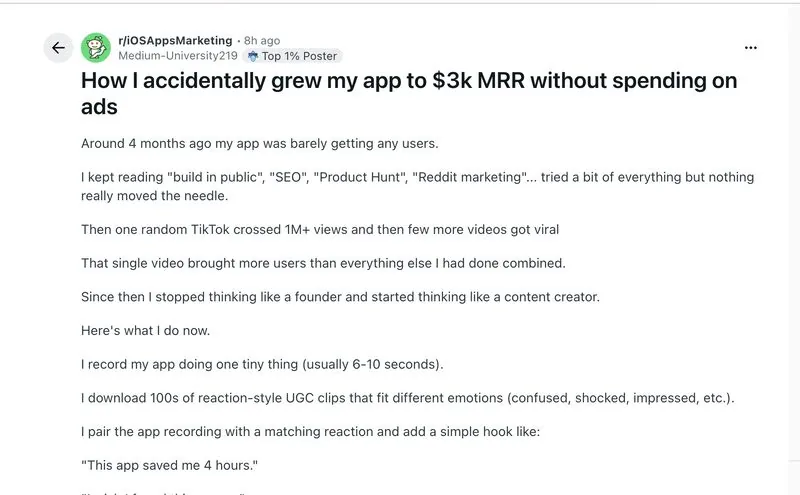
the same pattern shows up on the buyer side. one founder reached $3k mrr on zero ad spend posting one to two short videos a day, pairing a six to ten second app recording with a reaction clip that matched an emotion:
the alternative shape: buy the clip, not the gig
the marketplace model asks you to commission a video that does not exist yet. brief, wait, review, revise, repeat per seller.
the other shape is that the footage already exists and you filter it. our b-roll library is real creators already recorded across emotions, with the clip visible before you pay for it. you pick by the reaction you need rather than by seller rating, and the price does not move between orders. pricing is a fixed rate rather than a per seller negotiation, packages exist for running a batch, and custom orders cover the case where nothing in the library fits and you do need something shot to brief.
the honest trade is this. a library cannot give you a specific named person delivering your exact script. a marketplace can. what a library gives you instead is that you see the reaction before you buy it, which removes the single biggest source of waste in commissioned ugc: paying for a video and discovering afterwards that the expression is flat.
how to brief either way
whichever route you take, the same three checks apply.
- ask for the first three seconds first. if a seller will not show you an opening beat before full delivery, you are paying to find out.
- judge the expression, not the production. clean light and a steady frame are cheap and do not correlate with hook rate. a visible change of expression does.
- buy a batch, not a video. hook rate is a distribution. a single clip cannot tell you where you sit on it, and the winner is usually not the one you would have picked.
and one thing not to do: do not swap to ai generated footage to fix a cost problem. at $10 per video it is not even the cheap option, and it generates a face rather than a moment.
the short version
fiverr ugc works, and for one off orders or a specific look it is a reasonable place to buy. what it cannot do is tell you the number that decides the outcome, because no marketplace can report a hook rate on creative that has not run yet.
so stop optimising the gig price. the spread between $3 and $500 per video is real, but it is not what separates a clip that scales from one that does not.
the half second is.
if you want to see what that looks like before paying for it, the b-roll library is filterable by emotion and every clip is watchable in full first.
Ready to get UGC videos for your brand?
Real human creators, 48-hour delivery, full commercial rights. Starting at $9/video.