UGC content examples: 3 clips scored 75 to 92
every ugc example list on page one shows you finished brand campaigns. nice to look at, impossible to buy, and useless when you sit down to brief a shoot. these are three individual clips from our library with the emotion, the runtime and the score printed next to each one, playing inline, and available at the bottom of the page.


a ugc content example is one real clip you can watch, not a case study about a campaign. the useful version tells you three things: the emotion on screen, how long it runs, and how it scored. below are three from our own library, with all three numbers attached and the clip itself playing inline.
what the results page actually returns
we pulled the live results for "ugc content examples" and "ugc ad examples" on 21 august 2026. the shape is the same on both:
- the top organic slots go to cohley, the digital marketing institute, yotpo, billo, insense, firework, photoshelter and youscan
- pinterest ranks on both
- a reddit thread ranks at position 5 on "ugc content examples", titled around one person analysing 100 videos that went viral
- there is a video block and an image block on both, and an ai overview on "ugc content examples" but not on "ugc ad examples"
two things fall out of that.
the first is that google wants to show you footage and stills, not paragraphs. every list on that page is a gallery.
the second is more useful. eight of the ten organic results are vendors publishing screenshots of brand campaigns they ran. the reddit thread outranks half of them because it is one person looking at real videos and reporting what he saw. that gap is the whole opportunity.
the problem with a campaign screenshot
a finished campaign tells you a brand shot something and it worked. it does not tell you what to do on monday.
you cannot buy the clip. you cannot see how long it ran. you do not know which emotion carried the first second. you get a thumbnail, a logo and a sentence claiming a lift.
so here are three clips instead, with everything we know about each one attached.
example 1: confusion, 4 seconds, scored 80
ash, filmed in an office, four seconds long, scored 80.
she is typing, looks up, pulls a face that says "wait, what", gestures at the screen and goes back to typing.
why it works as an opener: confusion is the cheapest way to buy a second of attention, because a confused face makes the viewer ask what the person is looking at. the answer is your app. you have not sold anything yet, you have just bought the right to keep talking.
four seconds is also short enough that it costs you almost nothing if the hook underneath it fails.
example 2: curiosity, 10 seconds, scored 75
anet, filmed in a restaurant, ten seconds, scored 75.
iced coffee, earbuds in, looking around the room, then straight down the lens with a curious expression.
why it works in the middle: this is the beat almost nobody buys and almost every ad needs. the opener has already stopped the scroll, and now you need eight seconds where the viewer stays while you show the product. a face that is actively interested carries that stretch better than a face that is still shocked.
it also does not look like an ad. she is in a real restaurant, the audio is a real room, and there is no product in frame at all.
example 3: relief, 9 seconds, scored 92
sara, close up, nine seconds, scored 92. the highest scored clip of the three.
she starts distressed and ends in genuine laughter, hand over her mouth.
why it works at the end: the payoff shot is the one people skip, and it is the one that makes the ad feel like a story rather than a claim. the turn is the value. a face that is happy for nine seconds is a stock photo. a face that changes from one state to another in nine seconds is a before and after you did not have to narrate.
what the score is, and what it is not
the number next to each clip is our own 0 to 100 rating, attached to every one of the 5,217 clips in the library. it ranks clips against each other so you can sort a shortlist instead of scrubbing through everything.
it is not a platform metric and it is not a forecast. a clip scored 92 is not going to make a bad product sell. treat it the way you would treat a shortlist, not a guarantee.
you need a stack of examples, not one perfect one
this is the part every example roundup gets wrong. they present one campaign as a thing to copy.
dan published his own run of this on linkedin on 6 august 2026: one viral tiktok reverse engineered into a template, then fed clips and app demos until it printed a thousand native videos. four weeks later: 4m views, 60% us, one breakout past 1m, six more past 100k, at roughly $0.75 per video.
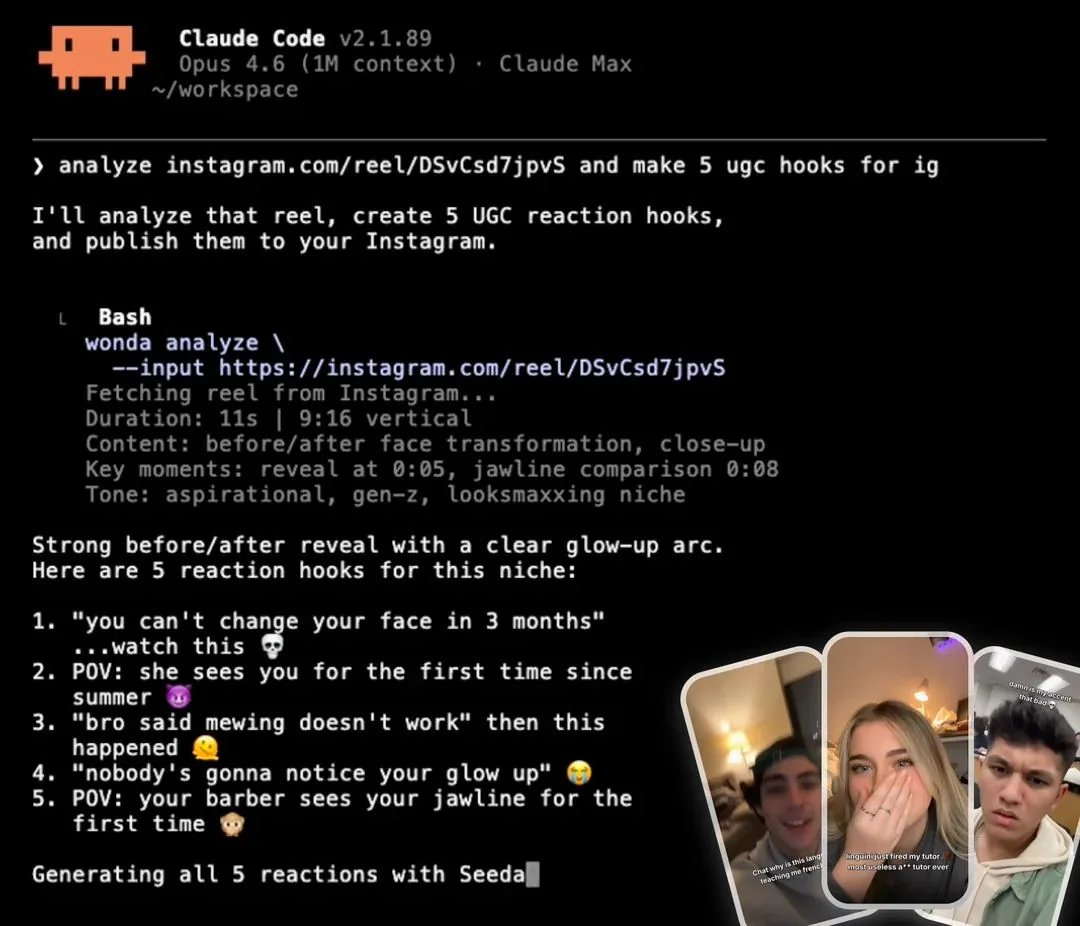
one video out of a thousand did the heavy lifting. you could not have picked it in advance, and neither could he.
his read on the target is narrower than most people assume. writing on 16 november 2025, you do not need millions of views for an app to take off, you need two or three videos at 100k that people actually comment on, share and bookmark.
that reframes what an example is for. you are not looking for the clip that will go viral. you are looking for enough distinct openers that two or three of them land.
the honest caveat
a clip that worked for someone else can do nothing for you.
dan has published both ends of that himself. on 30 october 2025 he posted a $4 ugc video that reached 500k views. the same account, the same sourcing, and most of the rest of that batch did not.
so the variance is real, and any example list that does not say so is selling you something. the response is not better example hunting. it is more openers, cheaper, tested against each other.
if you want the ai against human version of this argument with a customer's measured hook rate attached, it is written up in ai ugc against real human ugc.
where these three came from
all three clips above are in the b-roll library, which holds 5,217 clips filterable by emotion, location, length and score. that is the difference between this page and the rest of that results page: you can watch the example and then buy that exact file.
- pricing is per clip with commercial rights, not a seat or a subscription
- packages covers the case where you need a volume of openers rather than one file
- custom orders is for when you need a specific product in frame and the library cannot cover it
pick three emotions, not three clips of the same face. the fastest way to waste a month is to buy five versions of the same reaction and wonder why the tests all read the same.
Ready to get UGC videos for your brand?
Real human creators, 48-hour delivery, full commercial rights. Starting at $9/video.