How much do UGC creators make? Rates are not income
Separate UGC quotes, collected revenue, and operating costs. A practical income calculation with hypothetical examples—not an invented salary range.

UGC creators do not have one standard monthly income. What you make depends on the work you actually book, the amount you are paid, your production costs, and the time spent finding and serving clients. A quoted rate per video is not a salary, and a platform's selling price is not necessarily the creator's payout.
I run DansUGC, so I see this from the buyer and production side. The useful question is not “what is the biggest rate somebody posted?” It is “what work can I deliver, what will I actually collect, and what does delivering it cost?”
This guide gives you a way to answer that question without pretending that a handful of creator stories is a reliable industry salary survey. The worked numbers below are hypothetical, not DansUGC payout rates or reported creator results.
Start with three different numbers
Your quote is the amount proposed for a defined job. It might include filming, editing, revisions, or a particular usage arrangement. Until a buyer accepts it, it is not a booking.
Your collected revenue is the money you actually receive. A signed project and an unpaid invoice should not be counted as cash already earned. If a platform is involved, check which fees or deductions apply to your agreement.
Your amount after operating costs is collected revenue minus the expenses of delivering that work. It still is not necessarily your final personal take-home pay. This article does not calculate taxes or provide tax advice.
A fourth number matters just as much: all the hours you spent. Count prospecting, calls, preparation, filming, editing, revisions, delivery, and administration. Leaving out the unpaid work makes a project look much more profitable than it really was.
A simple monthly UGC income calculation
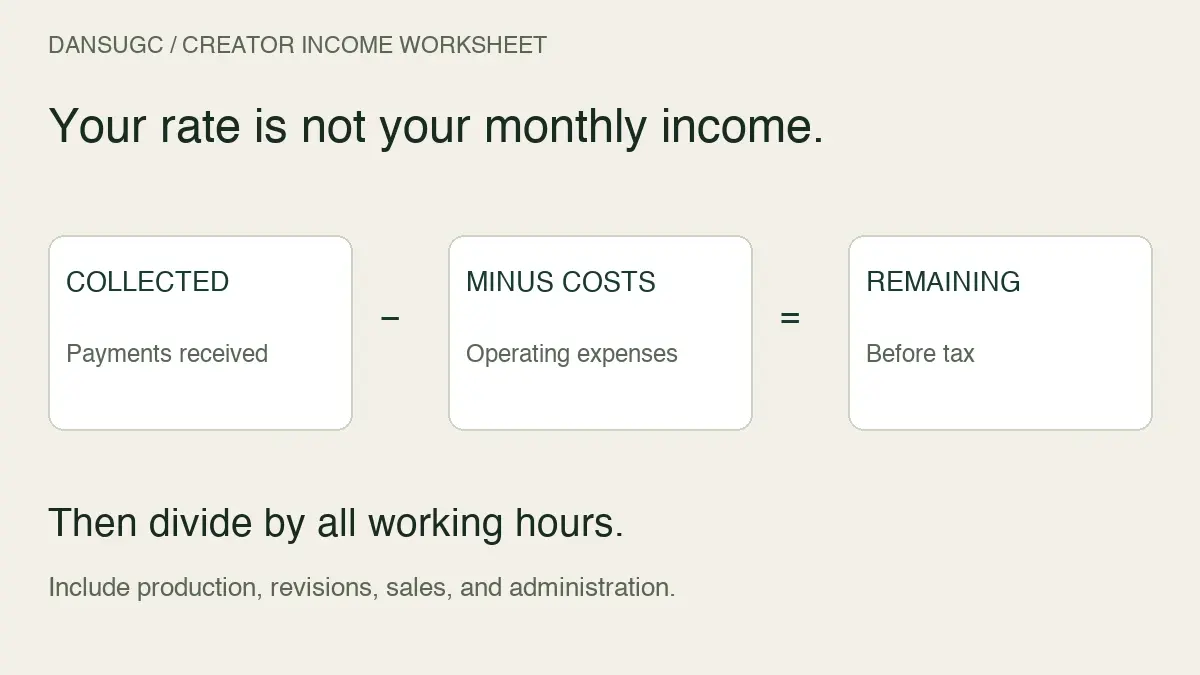
Use this starting point: collected project payments minus operating costs equals the amount remaining before tax. Divide that remaining amount by total working hours to estimate your effective hourly return before tax.
For example, imagine a creator completes four projects and collects $200 for each. They receive $800. Suppose their attributable operating costs total $120 and they spend 40 hours across production, sales, and administration. They have $680 remaining before tax, equivalent to $17 per working hour.
Those figures are an illustration, not a typical earnings claim. Change the number of paid projects, the costs, or the hours and the result changes immediately. Four more booked projects do not automatically fit into the same 40 hours.
Now imagine the same creator has only two paid projects that month. Collected revenue is $400, not the $800 their rate card might lead them to expect. Costs do not necessarily fall by half: some subscriptions, equipment costs, and sales effort remain. That is why you should build your plan around actual bookings rather than a full calendar you have not sold yet.
Why two UGC videos can have very different prices
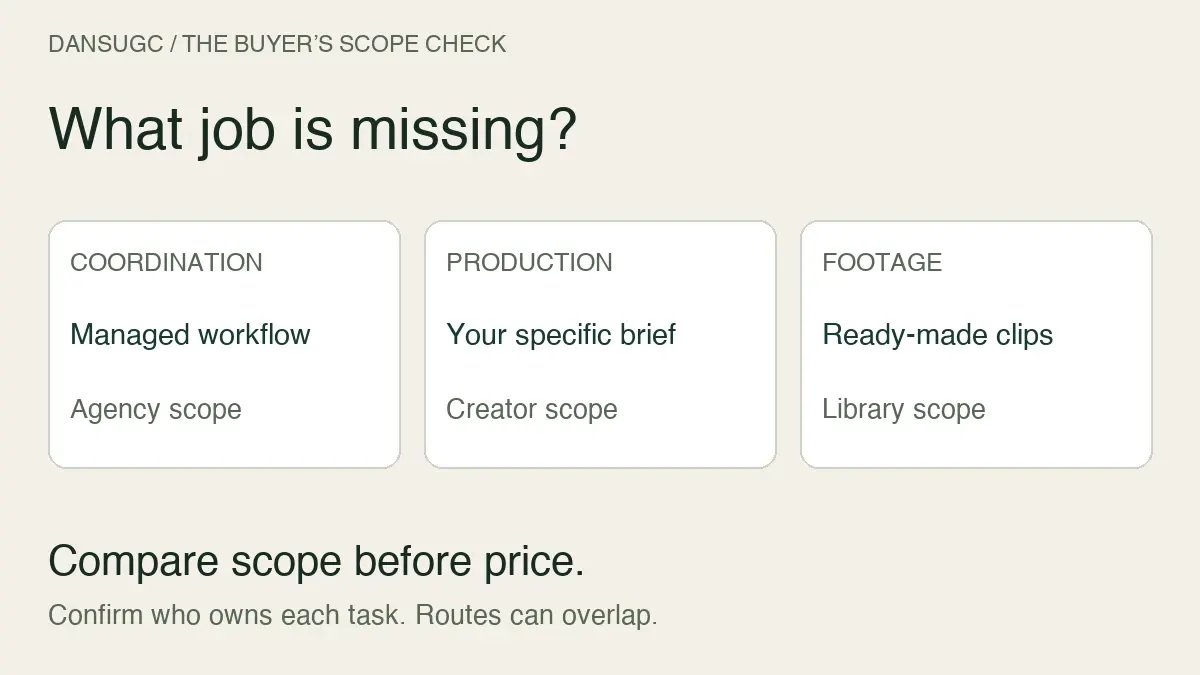
“One video” is not a complete specification. A short raw reaction, a scripted product demonstration, and a finished advertisement are different jobs.
A raw reaction brief might ask for a specific expression, setting, framing, and duration. A product demonstration can require learning the product, showing a real action, recording several scenes, and explaining a benefit accurately. A finished edit adds another layer: selecting takes, arranging the story, handling captions, and preparing the delivery files.
Posting to a creator's own audience is another separate deliverable. Do not assume that content production includes distribution, or that an audience is required for every production-only job.
Before comparing rates, write down the deliverables:
- What footage is required, and how many distinct scenes or concepts are involved?
- Is the buyer receiving raw files, edited files, or both?
- How many revisions are included, and what counts as a new brief?
- Where may the content be used, and for how long?
- Is exclusivity requested, and is it separately agreed?
- Must the creator post the content, or does the buyer publish it?
For the buyer-side version of this decision, see our UGC rate comparison guide. It helps distinguish the scope of a quote; it is not a creator salary benchmark.
A DansUGC library price is not a creator salary
As checked on October 5, 2026, the DansUGC homepage advertises library videos at $11 per clip and custom orders from $25 per video with a $250 minimum. Those are customer-facing offer prices. They are not a statement of creator compensation.
An earlier version of this article used historical founder posts about sourcing and resale prices. Those figures should not be treated as a current payout schedule, an industry average, or proof of what a creator earns each month. We have removed that comparison rather than carry old prices forward as if the offer had not changed.
We are not publishing a verified, current creator payout dataset here. For any actual engagement, use the compensation and deliverables in the agreement offered to you. Do not reverse-engineer your earnings from a library checkout price.
If you are evaluating the footage as a buyer, our UGC clips guide explains the format, and our real UGC video examples show what the assets look like in practice.
Repeat work helps only when the economics still work
A repeat client can reduce the time spent explaining your process and finding the next project. But a high-volume agreement is not automatically a good agreement.
Check whether each new batch requires new locations, props, scripts, or editing. Check whether feedback arrives in one clear round or many scattered messages. A lower unit rate with predictable, tightly scoped work might fit your business. A higher rate with extensive revisions might fit it better. You cannot decide from price alone.
My practical rule: make the deliverable easy to understand before you make it cheap. A clear brief and a clear approval process let both sides decide whether another batch is worth doing.
Use a pre-publish UGC quality checklist to define production readiness. Do not promise a particular view count or sales result simply because a clip passes an editorial review.
Keep a small earnings log
You do not need an elaborate dashboard to see what is happening. For each job, record the agreed scope, quoted amount, payment received, relevant costs, total hours, revisions, and whether the client booked again.
Review completed jobs at the end of the month. Which type of work paid reliably? Which briefs consumed more time than expected? Which buyers returned without requiring a fresh round of unpaid pitching? Use those answers to adjust what you offer next month.
Keep speculative opportunities separate from confirmed work. Keep confirmed work separate from received payment. This is especially important when you are starting: a busy inbox can feel like a business before it becomes collected revenue.
Frequently asked questions
How much do UGC creators make per month?
There is no single reliable monthly figure provided by this guide. Calculate your own collected project payments, subtract operating costs, and account for all working hours. A rate per video does not establish how many paid bookings you will receive.
How much can a beginner UGC creator make?
A beginner can have a month with no paid work. Do not budget around an assumed salary or somebody else's best month. Start with a defined deliverable, track the time it takes, and use actual accepted projects and received payments to build your estimate.
Do you need followers to earn from UGC?
Not for every type of work. In production-only arrangements, the buyer is purchasing content to use on its own channels. A deal that also includes posting to your audience has a different scope and should be evaluated separately.
Is the price a brand pays the same as the creator's payout?
Not necessarily. A customer-facing price may include services or platform costs beyond the creator's compensation. Check your actual payment agreement instead of assuming the retail price is your rate.
Where can a brand start with reaction footage?
Explore DansUGC's reaction library to see the available footage and current offer. If you need a specific production rather than existing clips, compare the current custom-order scope before choosing the route.
Ready to get UGC videos for your brand?
Real human creators, 48-hour delivery, full commercial rights. Starting at $9/video.